UCCA Beijing Closed Today,
UCCA Dune Closed Today,
UCCA Clay Closed Today,
UCCA Dune
Kim Lim: Water Rests, Stone Speaks
2025.10.26 - 2026.4.6
About
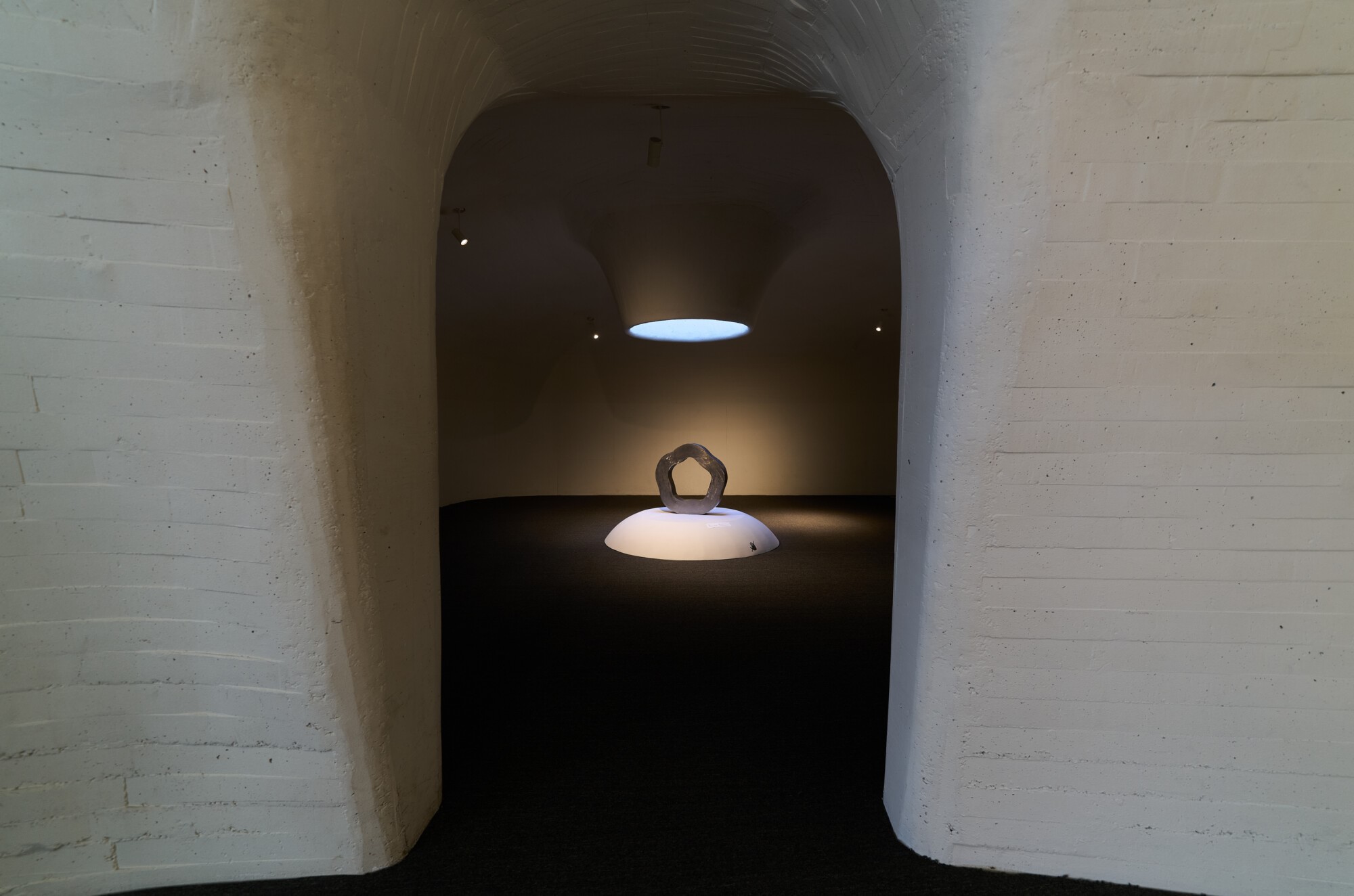
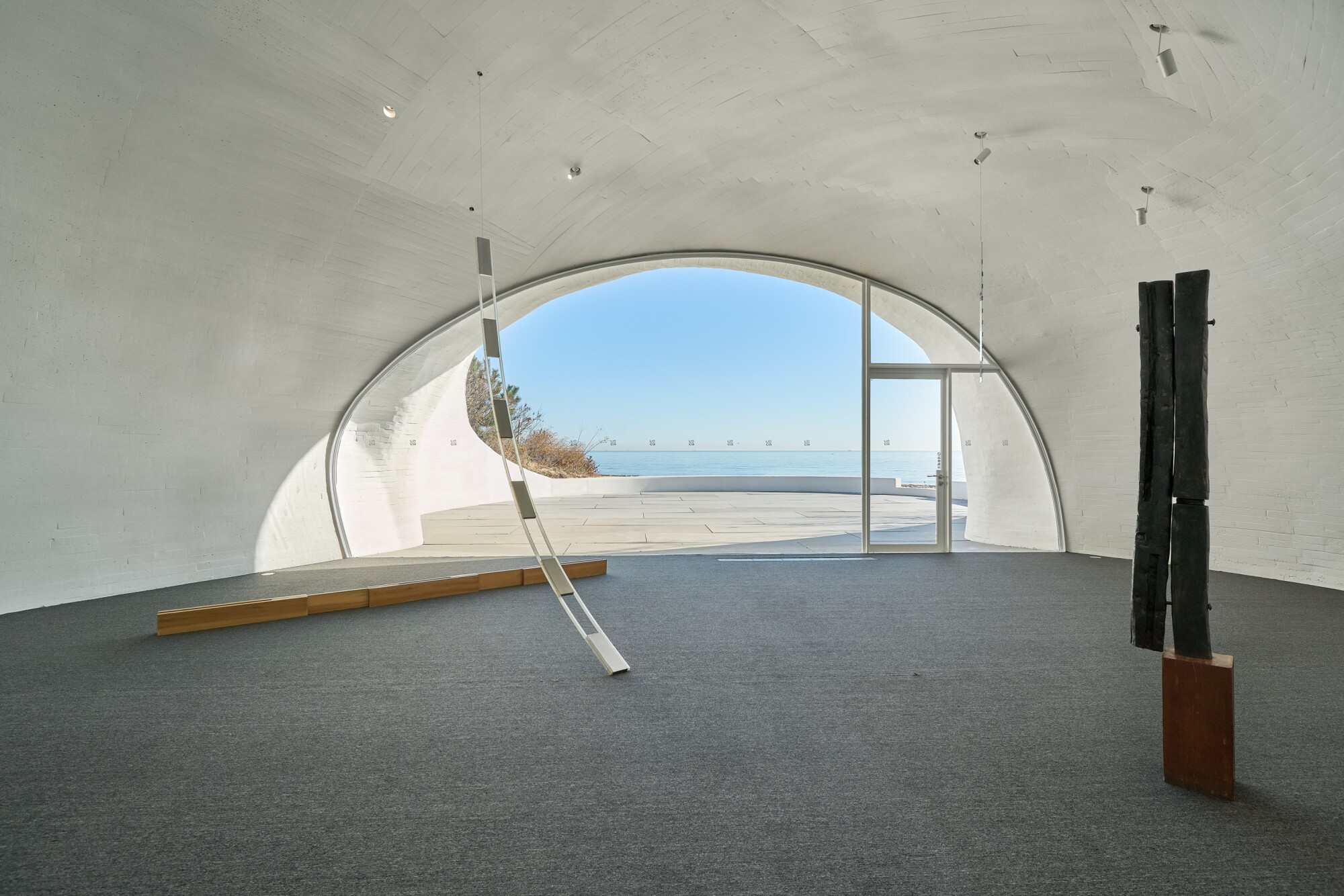
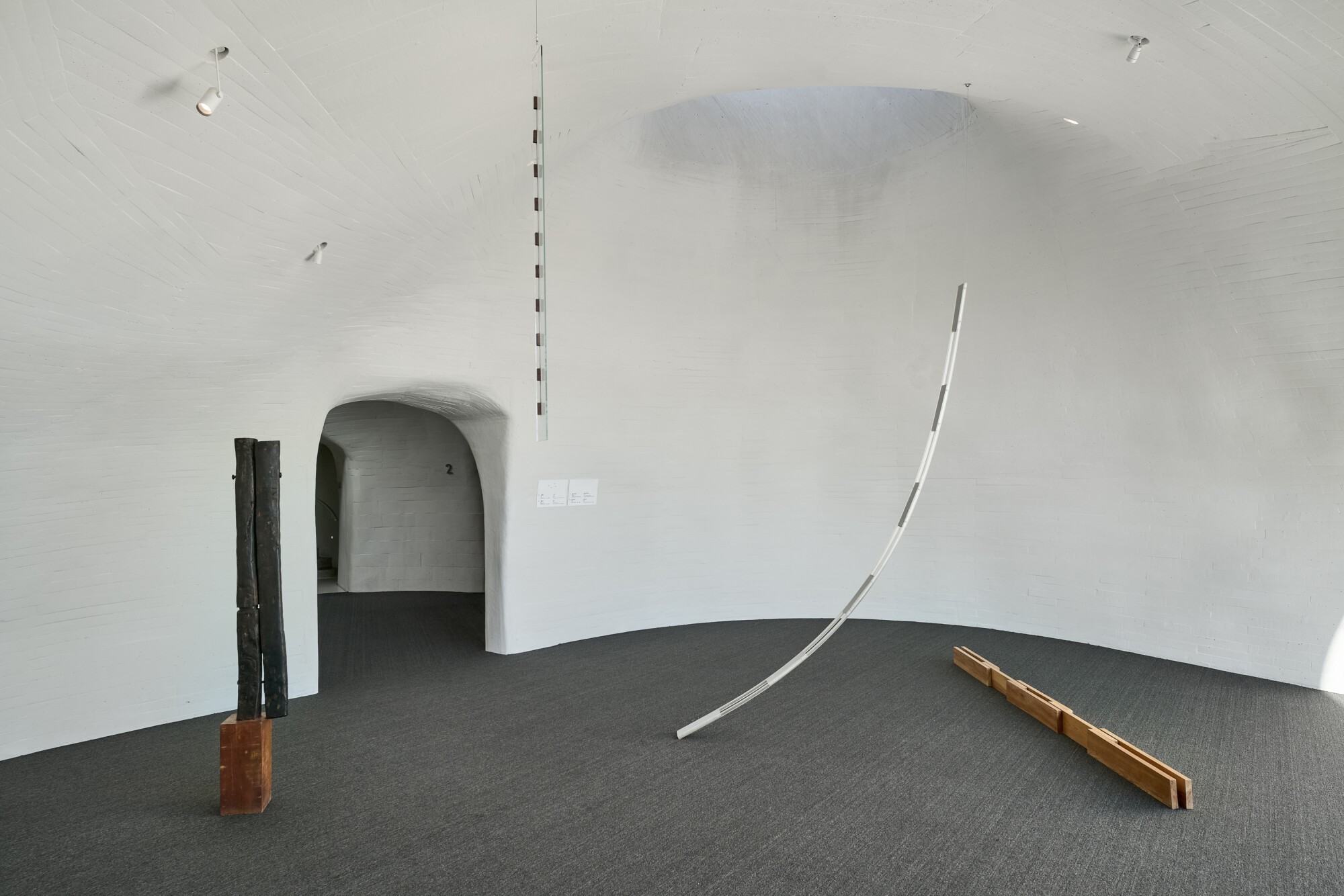
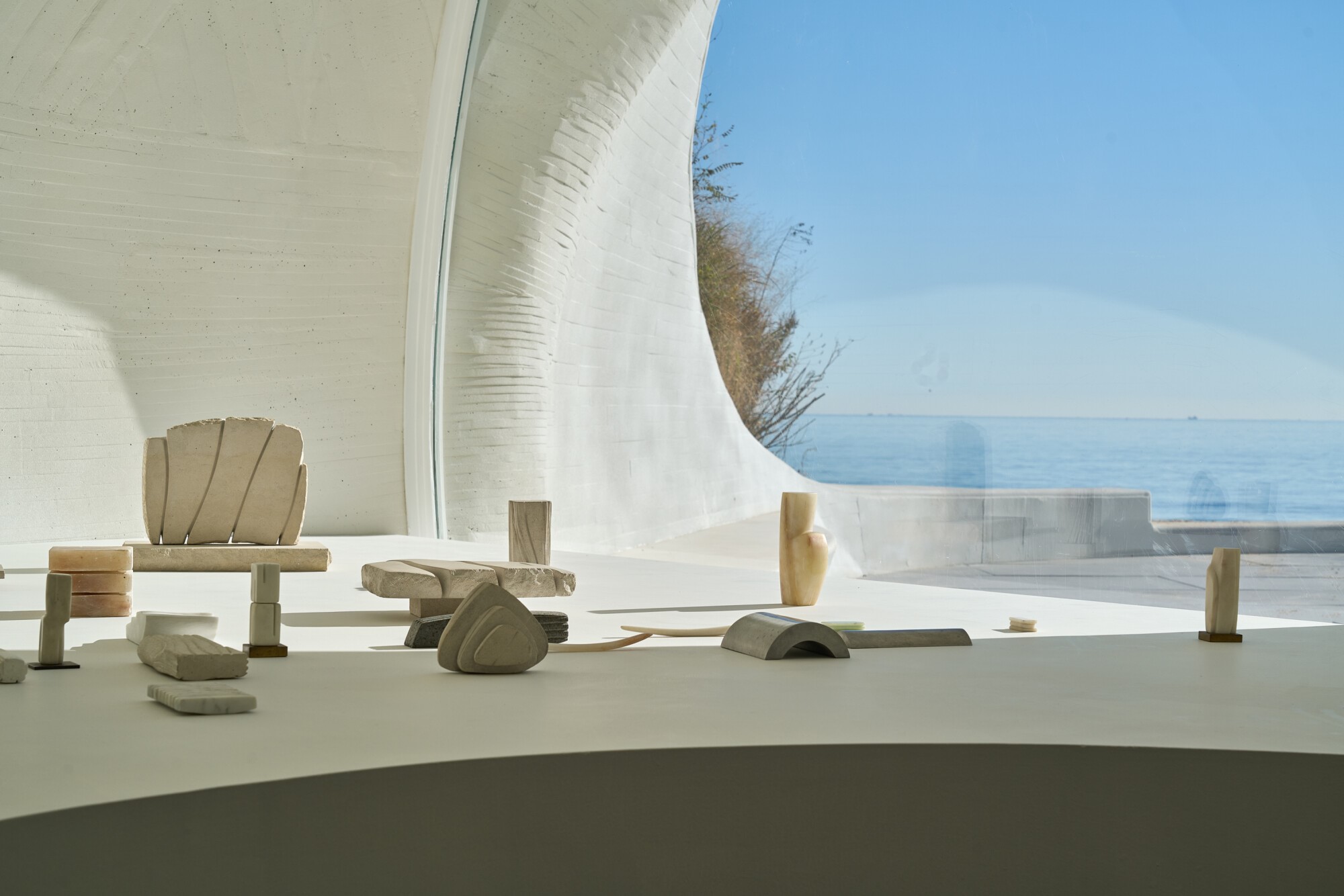
From October 26, 2025, to April 6, 2026, UCCA Dune presents “Kim Lim: Water Rests, Stone Speaks,” an exhibition of the late British-Singaporean artist of Chinese descent who worked primarily in sculpture and printmaking. This exhibition traces Lim’s explorations of form, rhythm, and light with sculptures, prints, and archival materials spanning three decades. Set against UCCA Dune’s interplay of sea, sand, and natural light, Lim’s meditative, minimalist forms transcend cultural and formal boundaries while revealing the expressive potential of materials: how stone might suggest the flow of water, how carved or printed surfaces capture the flicker of light, and how abstraction can convey subtle rhythms of life and form.
From October 26, 2025, to April 6, 2026, UCCA Dune presents “Kim Lim: Water Rests, Stone Speaks,” the first institutional solo exhibition in mainland China by the late British-Singaporean artist of Chinese heritage. This exhibition offers a profound exploration of Kim Lim’s (1936-1997) sculptural and print works spanning three decades, tracing her lifelong pursuit of rhythm and light in spatial relationships and material essence. Bringing together key works, including five prints from her “Dunhuang Series,” alongside archival photographs from her travels, the exhibition illuminates Lim’s elegant, minimalist investigations into the universal characteristics of form and space, as shaped by her experiences within Eastern and Western cultural contexts. This exhibition is curated by UCCA Curator Neil Zhang.
The exhibition title, “Water Rests, Stone Speaks,” derives from a Chinese idiom that may be more directly translated as “to rest by water and rinse with stones.” Traditionally associated with the figure of the recluse, the phrase evokes a life of independence and communion with nature. Reinterpreted here, it reflects both Lim’s artistic stance and the sensibility of her works—where the static appears to move, and the silent speaks in rhythms of shadow and form. The extraordinary seascape and natural light of UCCA Dune provide a setting uniquely attuned to Lim’s practice. Her works presented resonate with the surrounding landscape, dissolving boundaries between sculpture and site.
The earliest works on view, including Muse (1959) and Kiss (1959), reveal the foundations of Lim’s artistic vocabulary. Carved respectively in wood and stone, these pieces mark her initial explorations into how material form could evoke rhythm and intimacy without recourse to figuration. While Muse reflects her sensitivity to the tactile qualities of wood, Kiss—inspired by Constantin Brancusi’s sculpture of the same name—demonstrates her early fascination with reduction and balance. In these early carvings, the essence of her later practice is already apparent: a deep engagement with the relationships between weight and lightness, stillness and flow, structure and the organic.
Lim continued to refine this dialogue between medium and gesture throughout the 1960s and 1970s. Working fluidly between sculpture and printmaking, she regarded both practices as parallel modes of inquiry rather than distinct disciplines. The exhibition features excerpts from Lim’s notes that articulates this relationship: “the two activities—making sculpture and printmaking—are of equal importance to me.” Her “Ladder Series” (1972-1974) reflects this interchange, translating motifs from her sculptural language into prints that function not as preparatory sketches but as autonomous visual compositions.
Throughout her career, Lim’s extensive travels across Europe, East Asia, and Southeast Asia—as well as her layered identity as a Singapore-born, long London-based artist—deeply nurtured her visual language. One of the most resonant moments of this exhibition is five prints from her “Dunhuang Series” (1986-1988), shown alongside archival photographs during her travels in China around the same period. The interplay between carved form, spiritual space, and desert expanse that Lim encountered in Dunhuang would have a lasting influence on her practice. Together, these prints and photographs trace how her travels became a catalyst for artistic evolution, and reveal how Lim absorbed Asian visual traditions into expression within a broader constellation of cultural influences.
“Water Rests, Stone Speaks” highlights an artist whose practice transcended cultural boundaries. Through works that trace Lim’s lifelong exploration of rhythm, light, and the material essence of form, this exhibition reflects how her vision of abstraction continues to shape contemporary understandings of materiality and personal experience. By situating her work in dialogue with UCCA Dune and its extraordinary natural light and seascape, the exhibition underscores her status as an artist whose practice was both transnational and deeply personal. In this elemental context, her works dissolve the boundaries between material and environment, allowing viewers to experience her abstraction as a living dialogue between matter, movement, and perception.
Support and Sponsorship
This exhibition is presented in collaboration with the Estate of Kim Lim (London). Exclusive wall solutions support is provided by Dulux, and Genelec contributed exclusive audio equipment and technical support. UCCA also thanks the members of UCCA Foundation Council, International Circle, and Young Associates, as well as Lead Partner Aranya, Lead Art Book Partner DIOR, Lead Imaging Partner vivo, Presenting Partner Bloomberg, and Supporting Partners AIA, Barco, Dulux, Genelec, SKP Beijing, and Stey.
Public Programs
During the exhibition period, UCCA will collaborate with LAZYPRINT printmaking studio to host a hands-on printmaking experience, inviting participants to discover how Kim Lim explored spaces with hand-carved plates and printing, and how she expressed the quiet depth of nature and rhythm through simple forms and colors.
About the Artist
Kim Lim (1936-1997) arrived in London aged 17 to study at St. Martin’s School of Fine Art, later studying printmaking and sculpture at the Slade School of Fine Art. Two major exhibitions of her work in 2024 include “Kim Lim: The Space Between. A Retrospective” at the National Gallery Singapore, and “Daiga Grantina. Notes on Kim Lim” at the Kunstmuseum Appenzell, the artist’s first museum show in Europe. Other recent solo and group exhibitions include presentations at The Hepworth Wakefield, Manchester (2023-4); Turner Contemporary, Margate (2024); Whitechapel Gallery, London (2022); Barbican Art Gallery, London (2022); Tate Britain, London (2021); STPI Gallery, Singapore (2018); and Camden Arts Centre, London (1999). Kim Lim was also included in the 2023 editions of the Taipei Biennial and the Gwangju Biennale. Her works are held in significant collections including the National Gallery Singapore; Arts Council Collection, UK; Tate Collection, UK; and M+, Hong Kong.
About UCCA Dune
UCCA Dune is an art museum buried under a sand dune by the Bohai Sea in Beidaihe, 300 kilometers east of Beijing. Designed by OPEN Architecture, its galleries unfold over a series of cave-like spaces. Some are naturally lit from above, while others open out onto the beach. UCCA Dune presents rotating exhibitions in dialogue with its unique site and space, with a particular focus on emerging Chinese and global talents. Opened in 2018, UCCA Dune is supported by UCCA strategic partner Aranya, the seaside cultural and lifestyle community where it is located.
Exhibition Statement
Gallery 1
I grew up with very little art in Singapore. When I came to England and began doing art I began looking. My desire to work in art was an internal and personal thing, and had not much to do with my early cultural environment. I suspect that my empathy is temperamental; I prefer an art that has quietude and containment. This describes classical Western art, the art of the Greek orders, and of Brancusi and Matisse, as much as it does the art of the East. But this quietude and containment is more often to be found in Eastern art than in Western.
[…]
For me, the experience of sculpture, West and East, taught me what sculpture is about. Experience gave me motive to go on.
— Kim Lim, “The work of Kim Lim,” interview by Gene Baro, Studio International 176, no. 905 (1968): 187.
Looking back at the early work, although my concern was directed more towards a “single entity” that not only occupied but changed the surrounding space, the way I wanted the work to be “perceived” at once—where the spectator walking around it would not encounter a totally different experience by changing the perspective, but would just be adding to the knowledge of the piece, affirming that which he/she has understood of it—has remained the same.
The space the sculpture inhabits is also another involvement of mine.
There is the obvious prime position where it displaces everything else—the center of the room.
The areas I find particularly challenging to manipulate and occupy are: the area between floor and wall, corners, floor to ceiling.
Gallery 2+
My concern in sculpture is not so much for volume, mass, and weight, but rather with form, space, rhythm, and light.
I think of space as a physical substance—to be articulated, manipulated. To be trapped, squeezed by using the forms in a specific way.
Using form to punctuate space.
Using space as intervals.
Space as place – outside / inside
close to the ground / suspend / floating
corner spaces / floor / wall areas
Rhythm is another preoccupation of mine—the physicality of the feeling of rhythm makes it very sculptural for me.
By repeating a form, a rhythm is built up which adds to the resonance of a piece.
Using rhythm as a pulse—like a bridge in space.
Gallery 2&3
I sometimes draw from plant and rock and bone structures and am constantly amazed by the rhythmic structures in nature.
The work looks non-figurative, but the material comes from the seen and felt world.
“Visual reality need not necessarily be visual verisimilitude.”
Most of the time when one is working, whether it is drawing, painting, or making sculpture, one is trying to discover for oneself visual metaphors that are able to act as “triggers.”
I would like my work to be able to infer experiences beyond the piece itself. Infer rather than refer to something specific and particular.
Gallery 4
In works such as Intervals I and II and even more so in Link, light becomes an important element in the structure of the piece—making the work more “physical,” “comprehensible.”
The two activities—making sculpture and printmaking—are of equal importance to me. The difference being that sculpture, for me, is a rather slow process, while working on a plate or wood block can produce quick feedback—so that the ideas I am involved in during a period sometimes appear first in prints. […]
The work that follows “Interval Series” are pieces using mainly wood, and are a continuation of the same preoccupation with space, rhythms, and light. I avoid “development” because it seems to imply a progression that starts at one end in a linear way, whereas my pattern of working seems more cyclic—certain forms and ideas reappear, sometimes quite a few years later.
Gallery 5
Growing up in a society where the emphasis was on “Custom” rather than “Culture,” my exposure to art was limited. One could see classical Chinese scroll paintings, ceramics, and collections of ethnographic artifacts from S.E. Asia, but not much else.
The little that I knew of European Art was from reproductions, so the first encounters with “real” sculptures and paintings, prints, and pots in the great museums of London and Europe were unforgettable and thrilling, intoxicating, and bewildering at the same time.
Everything was consumed with equal enthusiasm and it took quite a while before I could digest this multicultural diet. I had to select and separate on one side the things I admired and respected and on the other, to recognize those objects—paintings, sculptures, whatever—no matter how insignificant, which triggered a response of affinity.
I suppose one accumulates on a kind of mental pinboard such experiences which some time later act as signposts, so that one can find one’s bearings, so to speak, in the process of discovering one’s identity.
— Kim Lim, 1994.
Gallery 6
Thoughts on stone—it’s heavy—it’s hard, but at the same time it’s fragile and can appear quite weightless.
You can have it razor-sharp—early flint tools—or make it smooth like a beach pebble.
It’s exciting working the different kinds of stone, exploring the possibilities and contradictions,
using it to work out my ideas.
But at the same time, trying not to make it look like something else.
I love the way it reflects light, captures it, deflects it.
Gallery 7
I have always been intrigued by the way shells were formed—growing in a circular spiral formation.
I cut seven wedged-shaped stones—not identical in shape or size, but sufficiently similar to keep the feeling of repetition.
I wanted it to have—if possible—the sense of pace, of tempo by controlling the height of each stone.
Starting low, rising slightly, then descending.
The incised lines linking one stone to the next and accentuating the sweep of the curve.
— Kim Lim, 1995.
UCCA Beijing
Closed Today, 10:00-19:00
798, No. 4 Jiuxianqiao Lu, Beijing
Tel: +86 153 1170 8837
UCCA Dune
Closed Today, 9:30-19:30
Aranya Gold Coast, Beidaihe
Tel: +86 335 7522 652
UCCA Clay
Closed Today, 9:00-18:00
West Entrance, Creative & Cultural Ceramic Avenue, Dingshu Town, Yixing City, Wuxi City, Jiangsu Province
Tel: +86 0510 8767 9989